
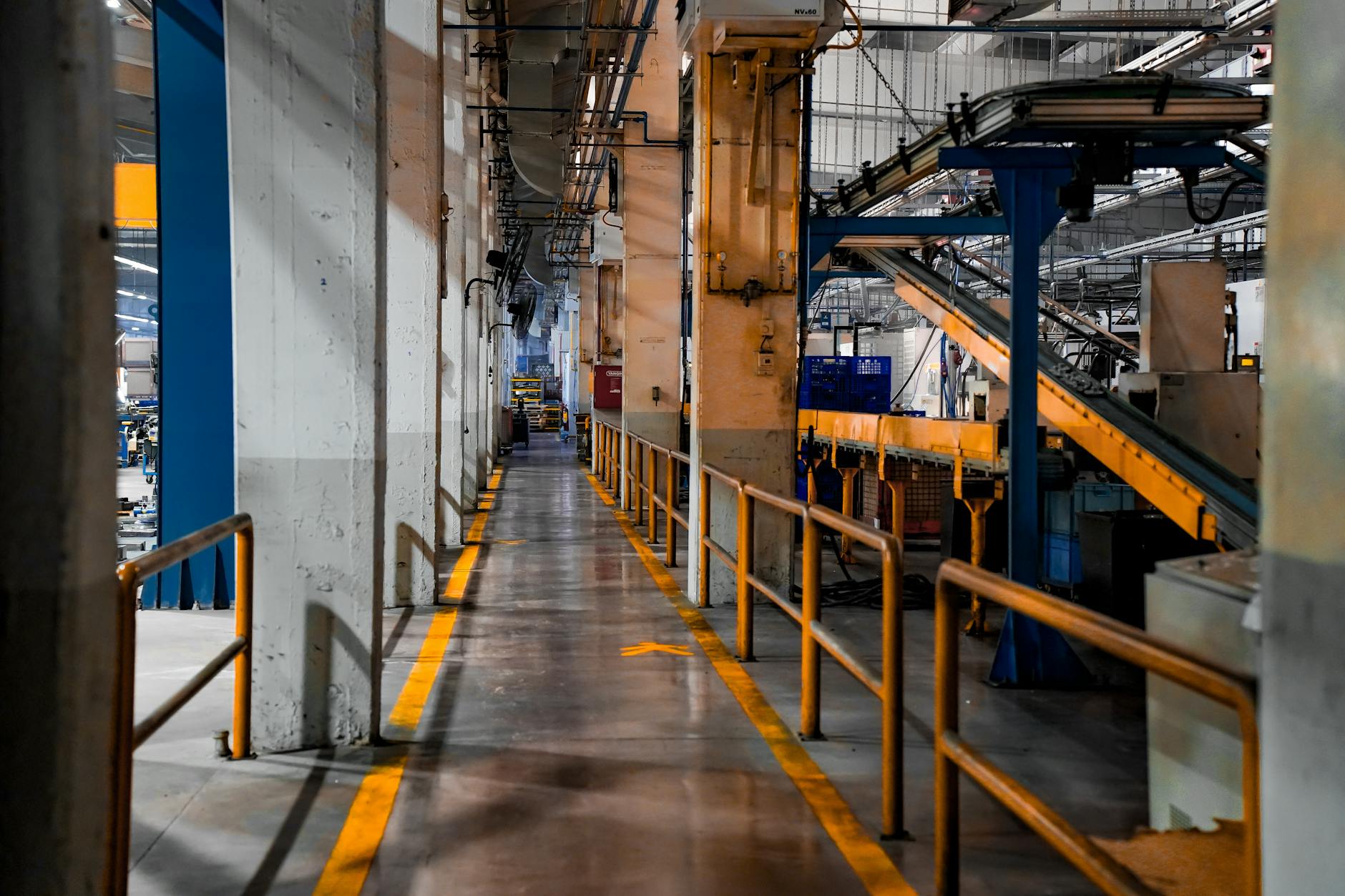
Walk into most small and mid-sized manufacturing shops in Norwood and you'll find the same network architecture that was installed a decade ago: a single flat network where the office computers, production floor terminals, ERP system, and even the break room TV all share the same broadcast domain. It works — until it doesn't. And when it doesn't, the consequences can shut down production for days.
The problem isn't unique to Norwood manufacturing firms, but the concentration of light industrial and precision manufacturing along the Mill Road and Floral Avenue corridors makes it a visible pattern in the Greater Cincinnati area. Shops running Epicor, SYSPRO, or Shoptech E2 for production management are particularly exposed — when ransomware hits the office network, there's nothing stopping lateral movement to the machine floor.
What "Flat" Actually Means in Practice
A flat network has no internal segmentation. Every device can talk to every other device unless a firewall rule explicitly blocks it — and most small manufacturers don't have those rules in place. An employee opens a phishing email on their workstation, ransomware executes, and within minutes it's scanning the local subnet for other targets. ERP servers. CNC machine controllers. SCADA interfaces. Everything on the same layer 2 network is reachable.
This matters because manufacturing environments have a unique mix of systems: modern Windows workstations running enterprise software alongside 15-year-old Windows XP embedded controllers that can never be patched because the machine vendor stopped issuing updates. You can't install endpoint protection on a legacy PLC. You can't patch it. Your only defense is making sure nothing malicious can reach it — and that requires network architecture, not just antivirus.
The IT/OT Convergence Problem
The push toward connected manufacturing — real-time production dashboards, remote diagnostics, ERP-to-floor integration — has made the IT/OT boundary nearly meaningless in many shops. That's good for efficiency and terrible for security. When the same network carries both the GM's email and the signals from a CNC controller, a compromise of either can affect the other.
Proper segmentation creates discrete zones: a business network for office systems and cloud services, an OT network isolated to production equipment and SCADA, and a DMZ for any systems that need to communicate between the two. Traffic between zones passes through a next-generation firewall with explicit allow rules — not an open bridge. A ransomware infection on the business network becomes a contained incident rather than a plant-wide shutdown.
What a Segmented Architecture Looks Like
In practice, this means deploying managed switches with VLAN support, configuring UniFi or equivalent firewall rules at the zone boundaries, and auditing every device to understand which network it belongs on. For most Norwood shops in the 20-150 employee range, this is a two-to-three week project, not a multi-year program.
Endpoint protection on the business network side matters too. Managed cybersecurity services that include SentinelOne EDR and Huntress MDR provide behavioral detection that catches threats traditional antivirus misses — including fileless attacks and living-off-the-land techniques that don't drop a recognizable malicious file. Pair that with a SIEM/MDR solution that correlates logs across the environment and you have visibility into lateral movement attempts before they succeed.
Backup architecture deserves attention in the same conversation. If production is down because ransomware encrypted your ERP database, recovery time depends entirely on when your last clean backup was and how long restoration takes. Veeam-based backup and disaster recovery with immutable offsite copies changes the calculus from "pay the ransom or rebuild from scratch" to "restore from last night's backup."
Defense Contracts and the CMMC Question
Norwood manufacturers with defense contracts — even indirect ones through prime contractors — are facing a harder deadline. CMMC 2.0 enforcement is moving forward, and Level 2 certification requires 110 NIST SP 800-171 controls, many of which directly address network segmentation, access control, and incident response. A flat network isn't compliant. Neither is an environment without documented system security plans, audit logging, or media protection procedures.
For shops that have been deferring this work, the window is closing. CMMC compliance assessments are now a prerequisite for contract renewals and new awards. The technical remediation and the documentation burden are both significant — starting that process now, before a contract requirement triggers it, gives you time to do it right.
Where to Start
The honest answer is: an assessment. Not a sales call. A real inventory of what's on your network, what's talking to what, and where the gaps are against a baseline like CIS Controls or NIST 800-171. Most Norwood manufacturers we work with haven't had that kind of structured review — and the findings are usually more actionable than expected. Network segmentation, endpoint protection, and a defensible backup strategy address the majority of the risk at a cost that's a fraction of a single ransomware incident.
Titan Tech works with manufacturers across the Greater Cincinnati area on exactly this kind of infrastructure work — from network redesign and structured cabling to fully managed cybersecurity and compliance support. If your shop is running on a flat network and you're not sure where the exposure is, reach out for a no-obligation assessment. We'll tell you what we find.