
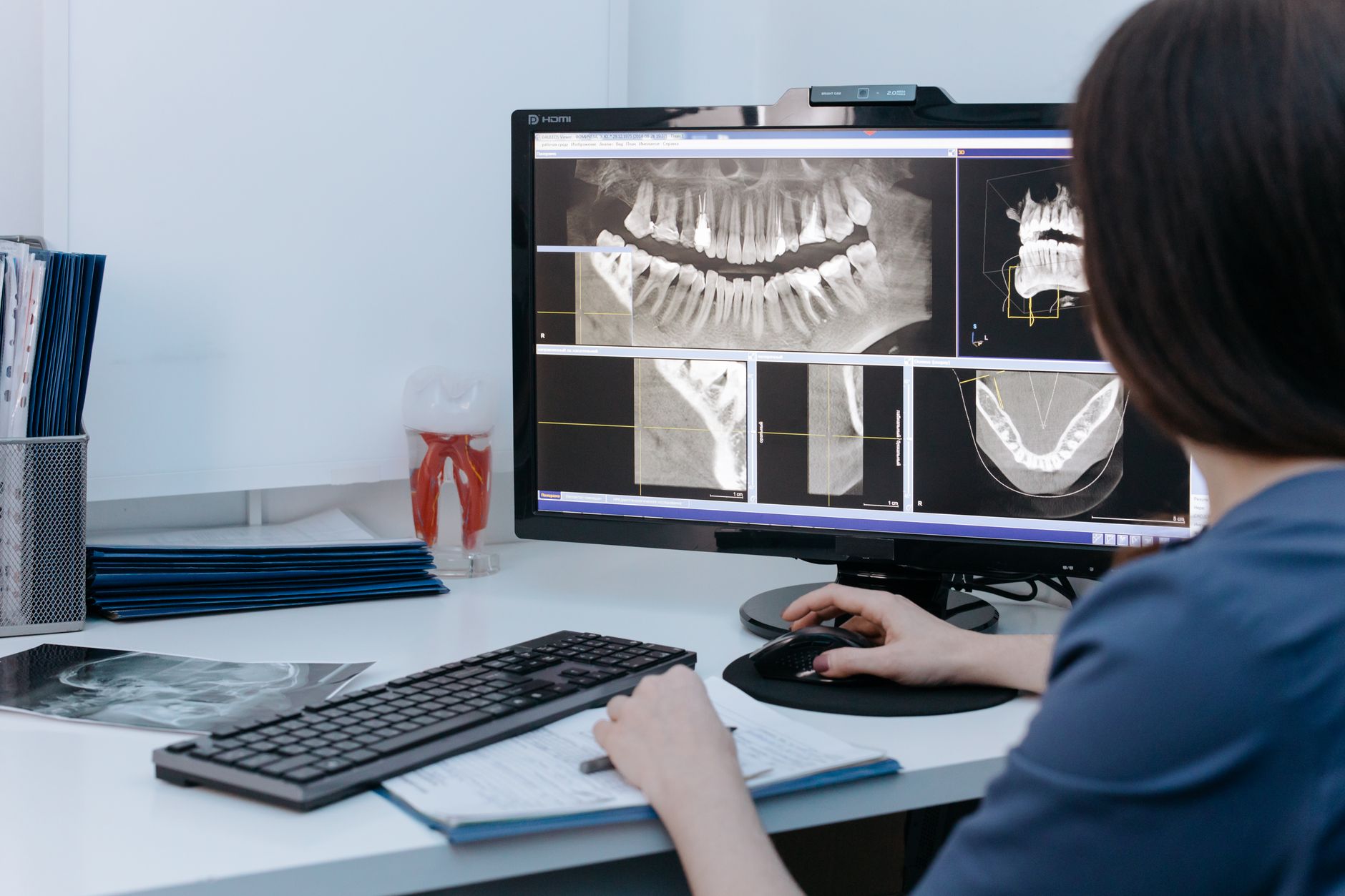
A dental practice can open Dentrix, Eaglesoft, or OpenDental and still be one failure away from losing access to years of diagnostic images. The weak point in Cincinnati dental cybersecurity is often not the practice-management database itself. It is the loosely documented chain connecting that database to imaging software, acquisition workstations, storage paths, sensors, and backup jobs. When those dependencies are treated as one generic “server,” a ransomware event or hardware failure turns a technical restore into a clinical shutdown.
A working schedule can hide a broken recovery plan
Practice-management and imaging systems commonly share patient identifiers without sharing the same database, storage location, or recovery process. The schedule and clinical notes may live in one application while panoramic images, intraoral X-rays, and 3D scans sit in another repository. An interface can make that separation invisible during normal operations. It becomes obvious only after a server is replaced or data must be restored.
This is why a successful nightly backup report is weak evidence. It confirms that a job ran, not that the restored environment can associate the correct images with the correct patient. A usable recovery test should start with a sample patient in a clean test environment, open the record, launch the imaging integration, retrieve older and recent images, and confirm that a workstation can acquire a new test image without changing production data.
Map the archive before choosing controls
The first useful document is a dependency map. It should identify the practice-management platform, imaging application, database service, image file path, acquisition computers, sensor or scanner interfaces, server names, service accounts, DNS dependencies, and the person responsible for each vendor relationship. It should also record which components are cloud-hosted and which remain inside the office.
That map frequently exposes unmanaged exceptions: an old Windows workstation kept alive for a legacy sensor, a vendor account shared across multiple offices, image files excluded from the main backup because of volume, or a database service running under credentials no one has documented. Those are operational risks before they are compliance findings. Replacing the server without accounting for one exception can leave clinicians unable to compare current images with prior studies.
Containment must preserve the clinical workflow
Dental networks should not place front-desk computers, imaging devices, guest wireless, voice systems, and building technology on one unrestricted network. Functional segmentation limits how far a compromised workstation can reach while preserving the traffic needed between approved clinical systems. Firewall rules should be based on documented application flows, not broad “allow any” exceptions added during installation.
Endpoint protection also needs clinical context. SentinelOne EDR and Huntress MDR can detect suspicious behavior, while SIEM monitoring correlates identity, endpoint, and network activity. But ownership matters: someone must decide which imaging processes are expected, how an alert is escalated after hours, and when a device should be isolated. Titan Tech’s managed cybersecurity services combine those controls with an operating response process instead of leaving alerts in separate vendor portals.
Recover the workflow, not just the files
A sound Veeam design protects each required workload, keeps a recovery copy separated from ordinary domain credentials, and tests restoration on a schedule. The test should measure clinical outcomes: Can staff find tomorrow’s schedule? Can a provider open treatment history and images? Can the imaging bridge locate the archive? Can a new image be captured and linked to the correct chart? How long does that sequence take?
Those answers define a defensible recovery-time objective. They also show whether internet access, Microsoft 365 identity, DNS, licensing services, or a vendor activation process will become the real bottleneck. Titan Tech’s backup and disaster recovery work is built around tested restoration because a backup that cannot reassemble the patient workflow is only stored data.
HIPAA evidence should match the environment
The HIPAA Security Rule expects an accurate and thorough risk analysis and reasonable safeguards for electronic protected health information. For an imaging-heavy practice, that analysis should cover the archive, acquisition devices, vendor access, authentication, audit records, network boundaries, and recovery procedures—not merely the main application server. It should be reviewed when systems, locations, vendors, or material workflows change.
Documentation should include the dependency map, access reviews, backup scope, restore-test results, identified exceptions, remediation owners, and dates. That evidence is more useful than a generic policy binder because it demonstrates how controls operate in the actual practice. A structured HIPAA compliance program ties technical work to risk decisions that practice leadership can understand and track.
If your Cincinnati dental practice cannot restore a patient record and its images as one tested workflow, contact Titan Tech to map the dependencies and run a recovery assessment.