
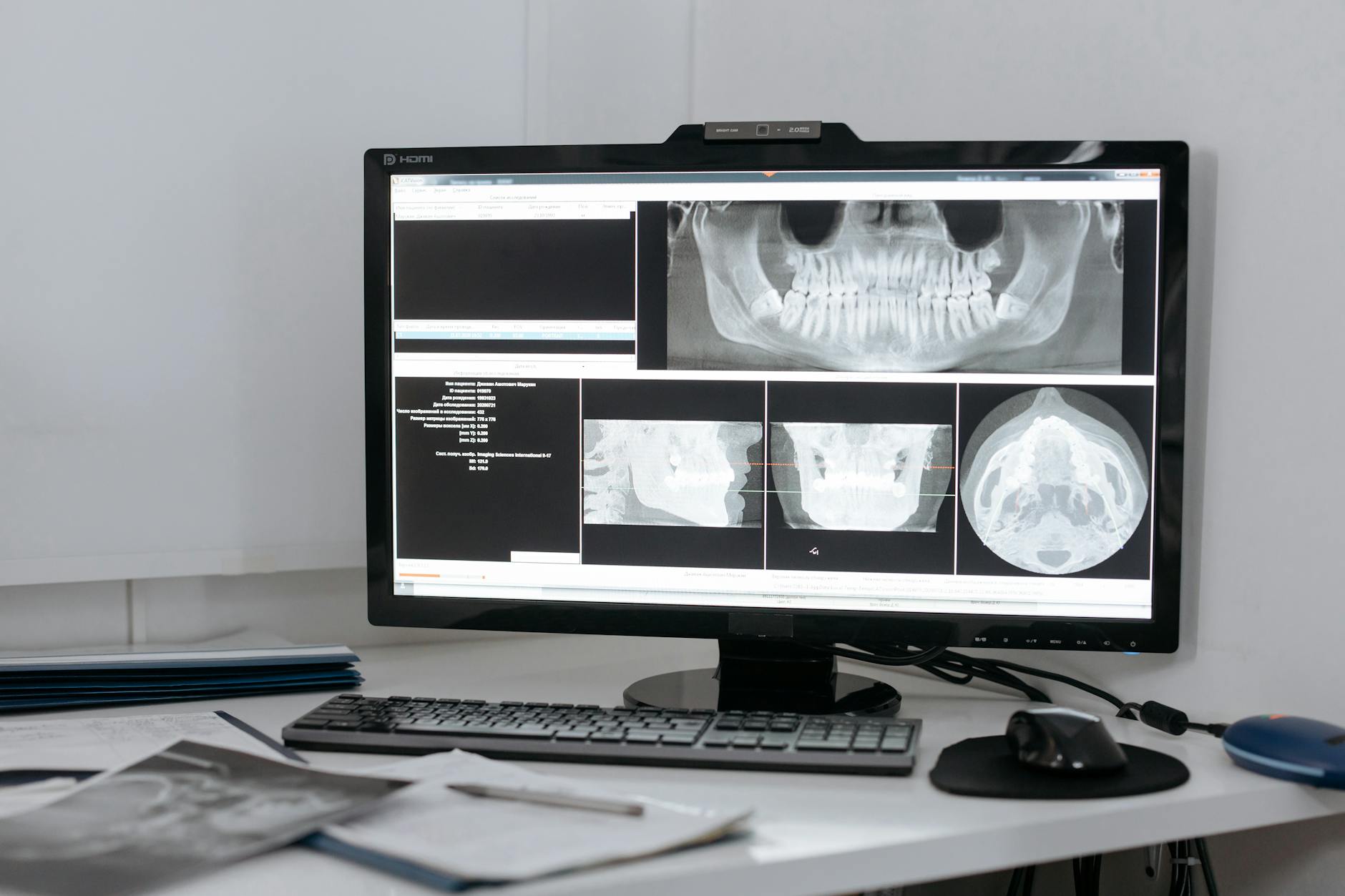
The HIPAA exposure in most dental practices isn't buried in their clinical software — it's in the infrastructure surrounding it. Anderson Township dental offices running Dentrix, Eaglesoft, or Open Dental handle protected health information (PHI) across front-desk workstations, digital imaging servers, patient-facing scheduling tablets, and billing systems, often on a flat, unmanaged network with no segmentation and backup routines that haven't been verified in years. That's the real Anderson Township dental IT compliance problem, and it's why dental has quietly become one of the most-targeted verticals for ransomware operators.
HHS enforcement data and breach notification reports bear this out. Dental practices account for a disproportionate share of small-provider HIPAA breach incidents, not because of sophisticated nation-state attacks, but because the infrastructure is predictably soft. A single compromised front-desk machine on a flat network gives an attacker direct reach to imaging storage, billing records, and practice management data with no lateral movement barriers in the way.
Why Dental Networks Stay Flat
Most dental practices built their networks incrementally — a few workstations, a server for the practice management system, a separate imaging workstation added when the panoramic unit went digital. Each piece was installed by whoever sold it, rarely with a network architect involved. The result is a single broadcast domain where patient records, credit card processing, employee devices, and clinical imaging equipment share the same Layer 2 segment.
Proper segmentation — separating clinical systems from administrative, isolating imaging hardware, putting guest Wi-Fi on its own VLAN — doesn't require a major infrastructure overhaul. But it does require a managed networking approach, not just a consumer-grade router and whatever switches came with the office furniture.
For practices using Dentrix or Eaglesoft, both vendors publish hardening guides and minimum OS requirements that the majority of installed instances don't meet. Dentrix, in particular, has specific SQL Server configuration requirements that, when ignored, leave the database layer unnecessarily exposed on the local network. Practices running older workstations to avoid the cost of upgrading their practice management license are compounding the risk — older Windows builds go unpatched, endpoint protection coverage lapses, and the imaging server that hasn't been rebooted in 14 months becomes the path of least resistance.
What HIPAA's Technical Safeguards Actually Require
The HIPAA Security Rule's technical safeguard requirements at 45 CFR § 164.312 are not vague. They specify access controls, audit controls, integrity mechanisms, and transmission security — all of which map to concrete IT configurations. What most dental practices in Anderson Township and across the Cincinnati metro lack isn't awareness that these requirements exist; it's a systematic way to verify they're being met.
A HIPAA risk analysis isn't a one-time checkbox. It's supposed to be a living assessment of where PHI lives, how it moves, who can access it, and what would happen if a system were compromised or lost. For a practice with a Veeam-backed server and a tested disaster recovery plan, that last question has a clean answer. For a practice whose "backup" is a USB drive that the front desk manager plugs in when she remembers, it doesn't.
Business Associate Agreements (BAAs) are another persistent gap. Every vendor with access to PHI — cloud fax services, patient communication platforms, IT support providers — is required to have a signed BAA on file. Practices that have cycled through vendors or adopted cloud tools during the pandemic-era telehealth surge often have unsigned BAAs or none at all.
The Ransomware Angle Specific to Dental
Dental practices are attractive ransomware targets for a specific reason: downtime is immediately and visibly painful. A practice that can't access its schedule, its patient records, or its imaging system can't see patients. Revenue stops the same day. That operational pressure creates the conditions ransomware operators exploit — practices pay because they have no tested recovery path and can't afford days of downtime.
Modern endpoint detection and response tools like SentinelOne, paired with a managed detection and response layer through Huntress MDR, change that calculus. Rather than relying on signature-based antivirus that misses behavioral indicators of compromise, EDR monitors for the patterns ransomware actually uses — lateral movement, privilege escalation, shadow copy deletion — and can isolate an endpoint before the encryption payload deploys. Titan Tech deploys both across dental clients as part of a managed cybersecurity stack that's sized for small practice economics, not enterprise budgets.
The backup piece matters just as much. An air-gapped or immutable backup with a tested restore procedure is the difference between a ransomware incident and a ransomware catastrophe. Veeam-based backup and disaster recovery, properly configured with offsite replication and documented recovery time objectives, gives a dental practice real options when an attack lands — including the option to not pay.
What a Realistic Assessment Looks Like
A credible HIPAA risk assessment for a dental practice in Anderson Township covers: network architecture review (segmentation, firewall rules, wireless isolation), active directory configuration and user access controls, endpoint protection status and patch levels across all workstations and servers, backup verification with a documented restore test, review of all third-party vendor relationships for BAA status, and a gap analysis against the HIPAA Security Rule's required and addressable specifications.
That assessment doesn't take months. For a 3–5 operatory practice, it typically takes a few days of structured work. What it produces is a prioritized remediation list — not a theoretical framework, but specific tasks in a specific order with cost estimates attached. Some practices find their exposure is limited and fixable quickly. Others find they've been operating with significant unmitigated risk for years without knowing it.
The practices that fare worst after an incident are invariably the ones that assumed compliance was handled because they had "a guy" or because nothing bad had happened yet. The practices that recover fastest are the ones with documented procedures, tested backups, and a managed IT relationship where someone is accountable for keeping the infrastructure current.
If your Anderson Township dental practice hasn't had a formal IT and HIPAA risk review in the past 12 months, contact Titan Tech to schedule one. We work with dental practices across the Cincinnati metro and can give you a clear picture of where you stand — and what it takes to close the gaps.