
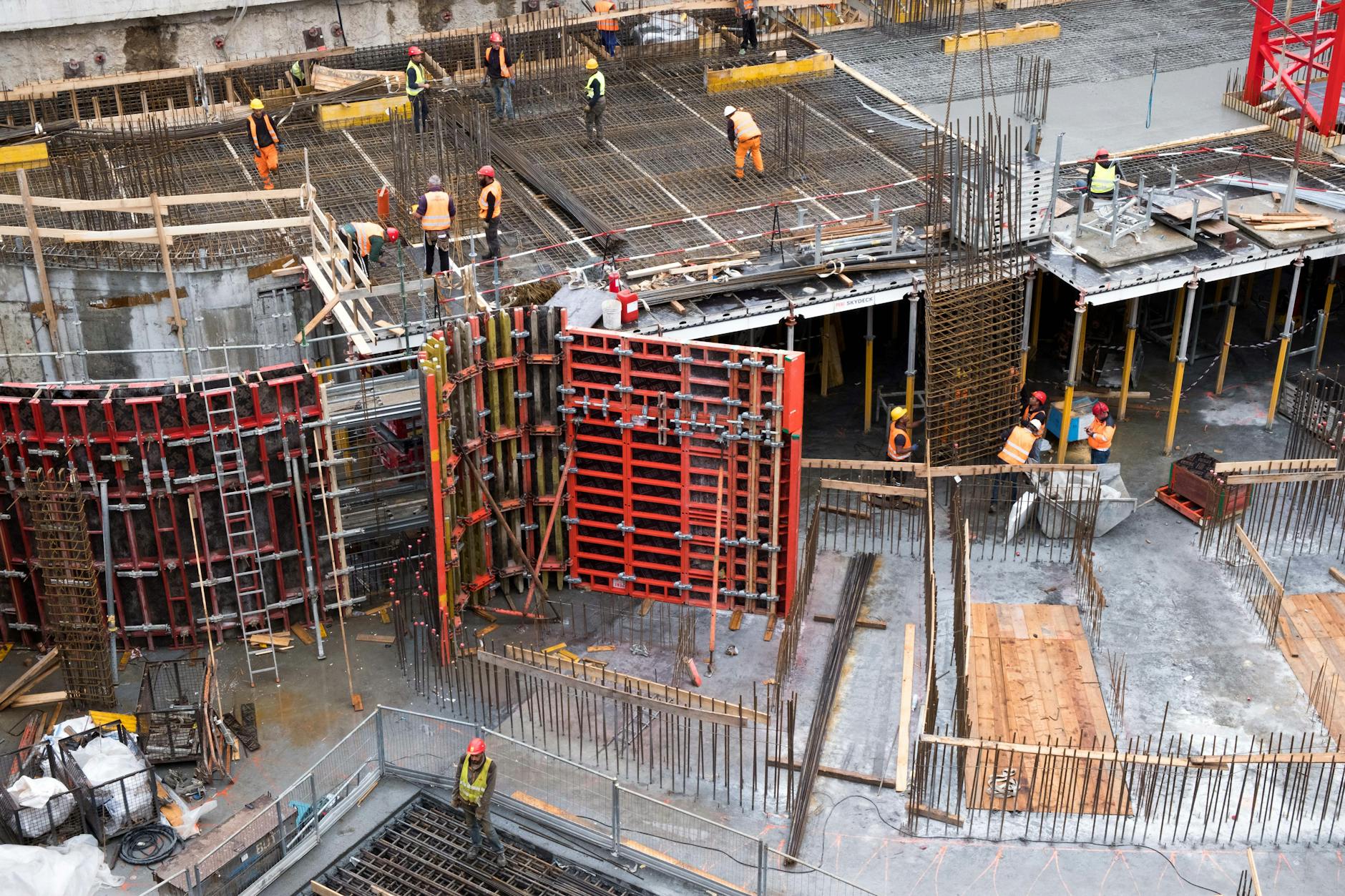
West Chester's construction sector has grown steadily over the past decade — commercial builds along Cox Road, residential developments pushing north toward Liberty Township, and a steady stream of industrial projects tied to the I-75 corridor. With that growth has come a quiet but compounding IT problem: networks built for speed and convenience, not security, running project management platforms and estimating software that attackers increasingly know how to exploit.
Ransomware groups don't go after construction because it's glamorous. They go after it because the margins on downtime are catastrophic and the security posture is often weak. A firm that can't access its Procore environment, pull bid documents from its file server, or process payroll for its subs doesn't wait around to negotiate — it pays. That calculus isn't lost on threat actors.
The Flat Network Problem
Most construction firms weren't built by IT departments. They were built by project managers and estimators who needed things to work fast. The result, in a lot of West Chester offices, is a flat network — one where the project manager's laptop, the accounting workstation running QuickBooks, the Wi-Fi access point in the conference room, and the NAS holding five years of CAD drawings all sit on the same subnet with no meaningful segmentation.
That architecture means a single compromised credential — from a phishing email, a reused password on a subcontractor portal, or a drive-by download on an unpatched machine — can give an attacker lateral movement across everything. One endpoint becomes the entire firm's exposure. Proper managed IT services include network segmentation as a baseline, not an upgrade.
Subcontractor and Vendor Access
Construction is a collaborative industry by nature. Subs get added to shared drives. Vendors get VPN credentials that never expire. Project owners get logins to estimating portals. Every one of those external touchpoints is a potential entry vector, and most firms have no systematic process for auditing or revoking that access when a project closes.
This isn't a hypothetical. The 2023 ransomware attack on a regional GC in the Midwest traced back to a subcontractor's compromised email account that still had active credentials to the firm's file-sharing environment — months after the sub's contract ended. The GC had no visibility into when that access had last been used.
The Software Stack Is Underprotected
Platforms like Procore, Autodesk Construction Cloud, and Sage 300 CRE are common across West Chester firms, and they're legitimate business tools — but they also represent a soft underbelly when credentials aren't managed with MFA enforced, session timeouts configured, and login anomalies monitored. Most construction firms using these tools have done the onboarding. Very few have gone back to harden the configuration.
On the endpoint side, construction workstations often run longer than their counterparts in finance or healthcare. A five-year-old Windows machine running an older version of AutoCAD isn't unusual. Legacy endpoints without modern endpoint detection — something like SentinelOne EDR paired with Huntress MDR — are sitting ducks for fileless malware and living-off-the-land attacks that traditional antivirus won't catch.
Backup Isn't the Same as Recovery
The other conversation that rarely happens until it needs to: backups. Most construction firms have some form of backup — whether that's a Synology NAS in the back room or a cloud sync configured years ago. What they often don't have is a tested, documented recovery process. There's a meaningful difference between having a backup and being able to restore your estimating environment, your accounting data, and your project files within a defined RTO when ransomware has encrypted your primary storage.
A proper backup and disaster recovery strategy for a construction firm means immutable offsite copies, tested restores at least quarterly, and a clear runbook for which systems come back first. Without that, a backup is just the illusion of protection.
What Remediation Actually Looks Like
For a typical 20-to-50-person West Chester construction firm, getting to a defensible security posture isn't a six-figure undertaking. It requires network segmentation between office and operational systems, MFA enforced on all cloud platforms and remote access, an EDR/MDR layer on every endpoint, a vendor access policy with defined review cycles, and a backup solution with tested recovery procedures. A SIEM and MDR layer adds 24/7 threat detection without requiring an internal security team.
None of that is exotic. It's the baseline that firms in more regulated industries take for granted — and that construction firms are increasingly being pushed toward by clients, insurers, and general contractors who require documented security controls before awarding contracts.
If you're running a construction firm in West Chester and the last time someone looked critically at your network was when it was installed, that's the conversation to start. Titan Tech works with construction and trades businesses across the Cincinnati area — reach out for a straightforward assessment of where your exposure actually sits.