
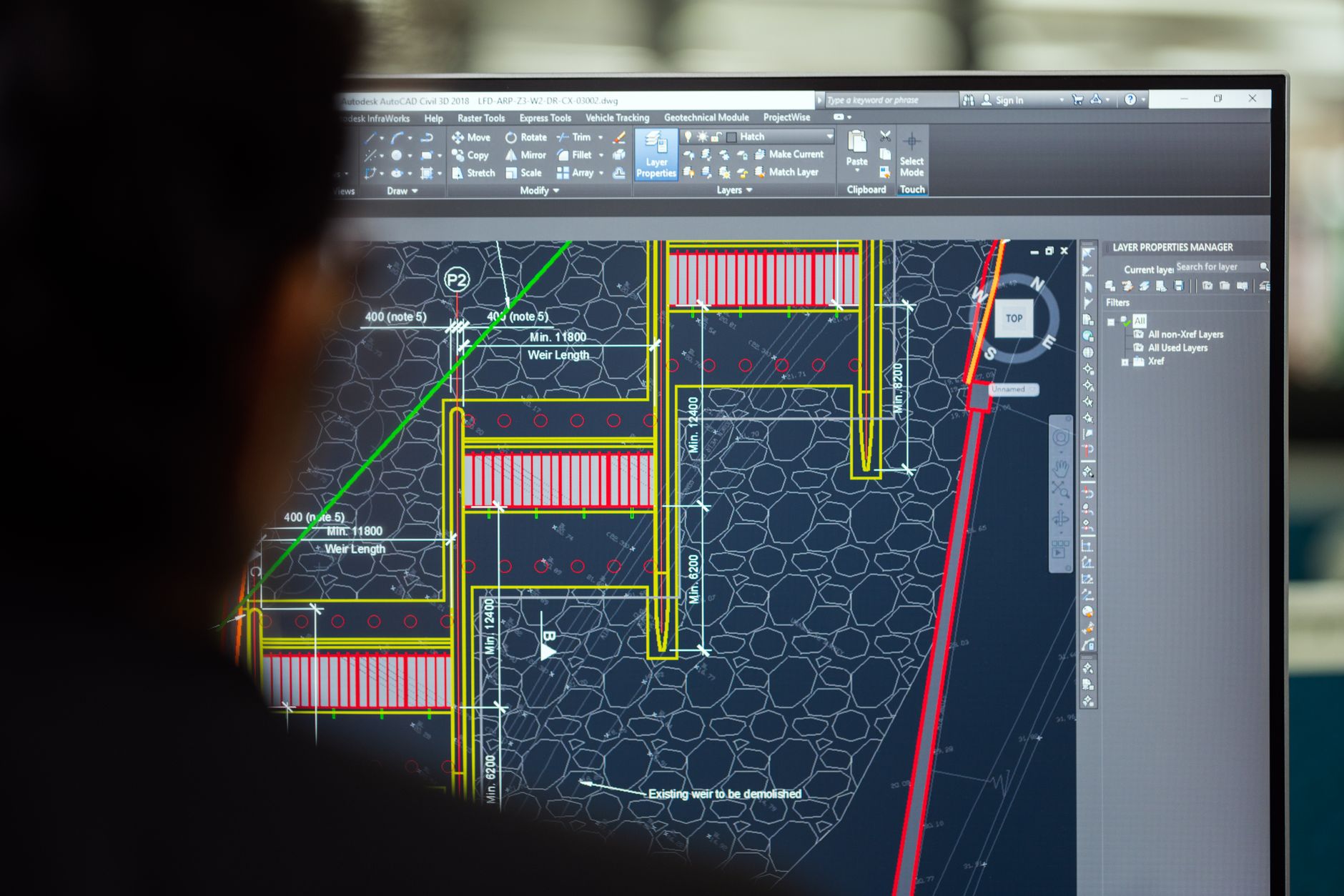
For most Covington engineering firms, the crown jewels are not in the cloud — they are sitting in a CAD file server in the back office. Structural models, P&IDs, proprietary fabrication drawings, and client survey data accumulate in shared folders that have grown organically for a decade. The team keeps working, projects keep shipping, and nobody notices that the permissions have drifted, that three former employees still have read/write access, or that the AutoCAD and Revit project directories are on the same flat network segment as accounting, reception, and an unsecured guest Wi-Fi. That accumulation is the state of Covington engineering cybersecurity at most small and mid-size firms, and it is exactly what a ransomware actor or a departing subcontractor is counting on.
Design files are uniquely hard to protect because they are messy on purpose. A single civil or structural project touches AutoCAD Civil 3D, Revit, Tekla, and often Bluebeam for markups, with external consultants pulling revisions in and out. Engineers need to move large files quickly, so firms resist boundaries that slow the workflow. The result is a flat network where the CAD server, the file shares holding client NDA materials, and the endpoints all sit in one broadcast domain. Any compromised workstation — a sales laptop opened a phishing link, a CAD operator clicked a malicious attachment — can reach the entire design library sideways, no credentials required beyond the one machine.
That matters more in Covington than in other markets because of the client mix. The city’s engineering base leans heavily on industrial, municipal, and manufacturing work, often under contracts that bind the firm to protect proprietary process data and third-party designs. A leak of a manufacturer’s tooling drawings, a client’s equipment layouts, or pre-bid pricing documents is not just an embarrassment; it is a contractual breach and a reputational event that shows up in the next request-for-proposal. Under Kentucky’s data breach notification statute, an actual exposure of personally identifiable information in a firm’s HR or client files triggers a legal reporting clock, not an IT inconvenience.
The first fix is segmentation, and it is a managed IT conversation, not an engineering one. Put the CAD server, version-control repositories, and client-confidential shares on their own VLAN with access controls that follow the principle of least privilege, and put guest Wi-Fi and phone systems on isolated segments. This is the same architecture that manufacturing clients are now being forced into under CMMC 2.0, and the same logic applies to any firm handling third-party design IP. It turns a single compromise on the sales floor from a firm-wide event into a contained incident. Our managed IT services team routinely walks firms through this VLAN and permission redesign in Covington and the surrounding area.
Segmentation alone does not fix access sprawl. The directory is still full of inherited permissions, shared mailbox folders, and freelancers who were never deprovisioned. Do a real review: map who can read, write, and delete in every CAD and NAS share, compare it against the current headcount and contractor list, and remove anything that does not match. Pair that with Microsoft 365 conditional access so that any login from an unrecognized device or location is challenged by MFA rather than silently let in. Our Office 365 practice can stand this up in days, and it closes the remote-engineer loophole that delivers most of the credential-based breaches we see.
Because the files are the business, the backup has to be treated as a recovery contract, not a scheduling checkbox. Veeam backups of the CAD server, the file shares, and the M365 tenant are only as good as the restore test. A point-in-time recovery of a 60 GB Revit central model is a different exercise than restoring a mailbox, and most firms have never tried. Run a quarterly restore of a real project directory, verify the RPO and RTO against what the contracts actually require, and hold a copy offsite or immutable so a ransomware variant that encrypts the primary storage cannot encrypt the recovery path. That last point is the one that separates firms that pay the ransom from firms that simply restore and move on.
Detection is the layer most Covington engineering firms skip. CAD operators ignore alerts, and there is usually nobody watching the logs for lateral movement anyway. Endpoint detection and response from SentinelOne, managed detection and response through Huntress, and SIEM correlation for the network give a small firm something it rarely has: eyes on the environment after hours. Managed security services and SIEM/MDR package this so the firm is not hiring a security analyst it cannot justify, and so a beaconing workstation gets caught before it becomes an exported design library.
The pattern in Covington is consistent: the firm that treats CAD data as just another folder ends up with a compromise that costs a client and a reputation, while the firm that segments the network, audits access, and actually tests its restores absorbs the same attack in an afternoon. The difference is not budget; it is treating design IP as infrastructure instead of as shared storage.
If your engineering firm is still running a flat network with unmanaged CAD shares, start with a network and access review. Contact Titan Tech and we will map the exposure, segment the design network, and put a tested backup and detection plan in place before the next phishing email finds its mark.